Welcome to Bangladesh Railway — Your Most Trusted Way to Travel
For over 160 years, Bangladesh Railway has been the heartbeat of the nation’s transportation network. Every day, millions of people across Bangladesh step onto a train — heading to work, visiting family, or starting a long-awaited trip to the coast. That’s Bangladesh Railway: affordable, familiar, and part of everyday life here.
Getting on a Bangladesh Railway train means joining a network that runs 97+ intercity trains across 3,600 kilometres of track, connecting every corner of Bangladesh from Tetulia in the north to Cox’s Bazar in the south. Check schedules, track your train live by sending an SMS to 16318, or book your e-ticket — it’s all here on one page.
| 3600+ km Rail Network Length | 44 Districts Connected Across Bangladesh | 450+ Trains Running Daily | 160+ Years Serving the Nation |
How to Book Bangladesh Railway Ticket Online — Step by Step
Booking online is genuinely easier than most people expect — and once you’ve done it once, you’ll never queue at a station counter again. Here’s exactly how it works, step by step.
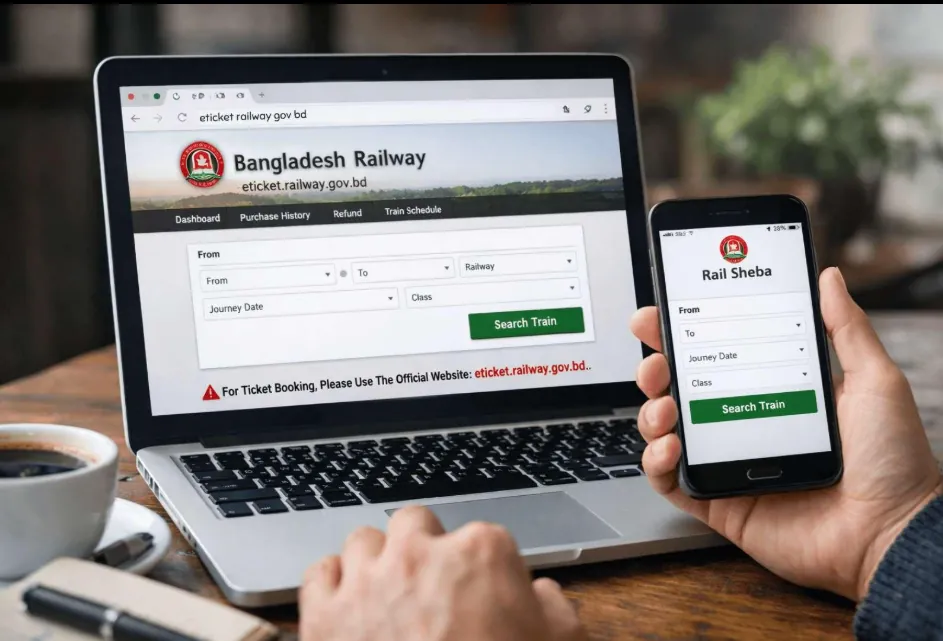
1- Go to the Bangladesh Railway E-Ticketing Website Open your browser and visit eticket website for Bangladesh Railway online ticket booking.
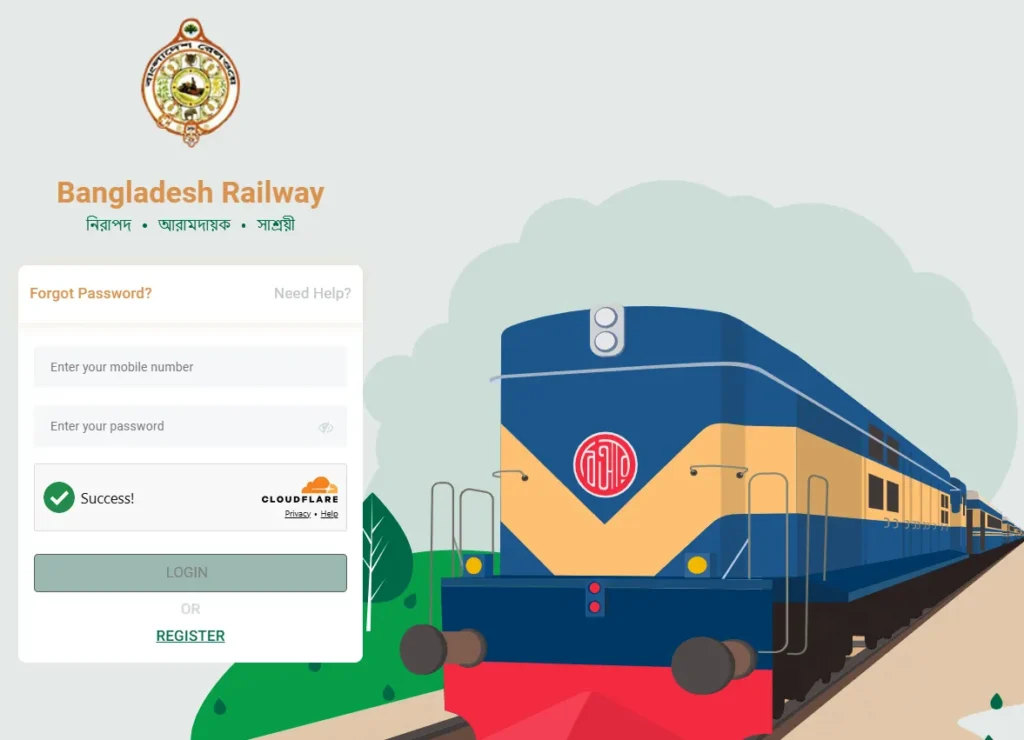
2-Create an Account or Log In If you are a first-time user, click on “Register” and sign up using your mobile number and National ID (NID). It takes less than 2 minutes. If you already have an account, simply log in with your registered mobile number and password.
3-Enter Your Journey Details Fill in the search form with your departure station (From), destination station (To), date of journey, and preferred seat class. Then click the “Search Train” button. All available trains for that route and date will appear on your screen.Find your preferred train and click the Book Now button to continue to the official Bangladesh Railway booking portal.
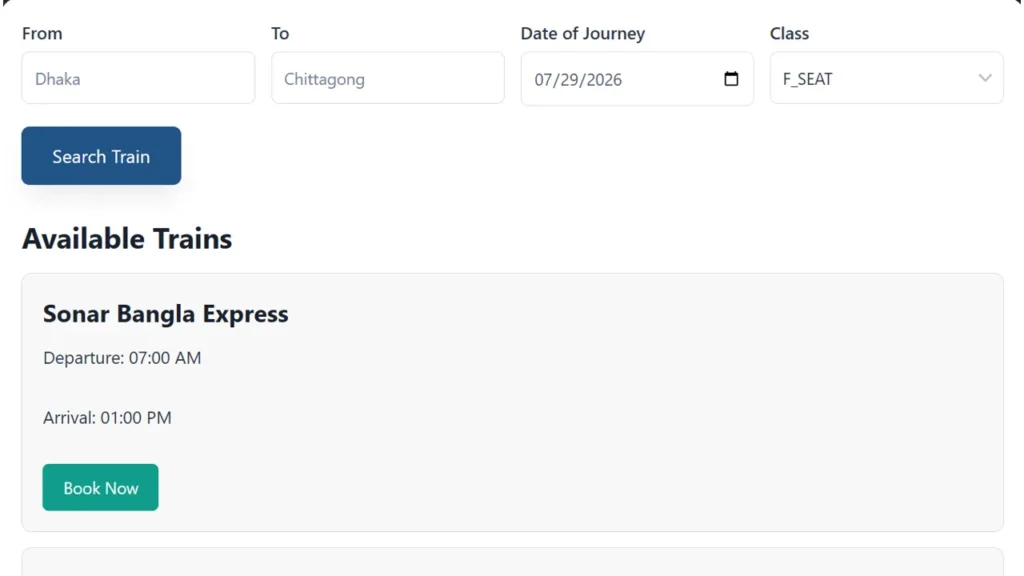
4-Choose Your Train A list of available Bangladesh Railway trains will show up with departure time, arrival time, journey duration, and seat availability. Pick the train that best fits your schedule. You can see how many seats are still available before making any selection.
5-Select Your Seat Class Bangladesh Railway offers multiple seat classes — S-Chair, Shovan Chair, First Class Seat, Snigdha (AC Chair), and AC Cabin. Choose the class that suits your comfort and budget. The fare will be clearly shown for each class so there are no surprises.
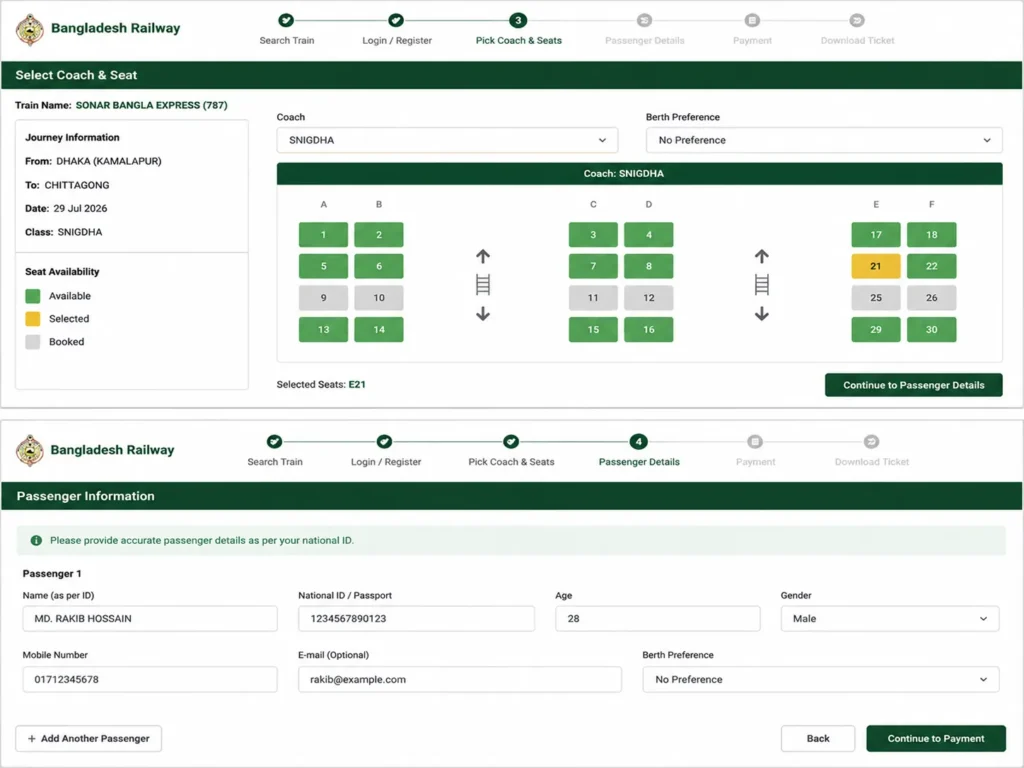
6-Pick Your Seat from the Seat Map Once you select a class, an interactive seat map will appear. Green seats are available, red seats are already booked. Simply click on any green seat to select it. You can book up to 4 seats at a time per transaction.
7-Review and Confirm Your Booking A summary screen will show your selected train, seat, date, class, and total fare. Read everything carefully before moving ahead. If all details look correct, click “Confirm” to proceed to the payment page.
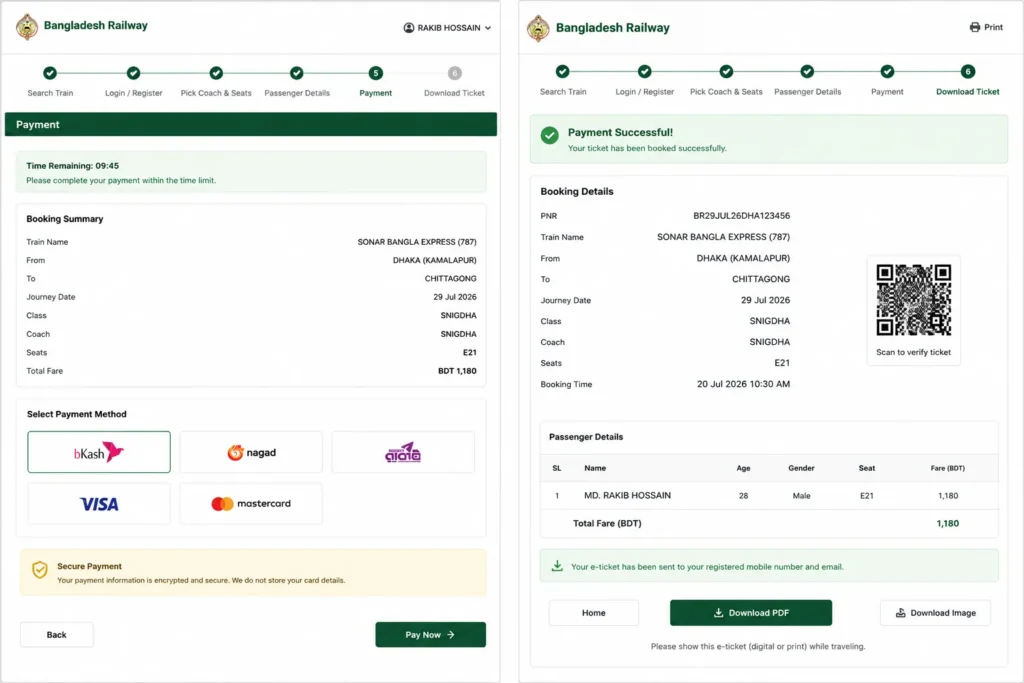
8-Make the Payment Bangladesh Railway accepts multiple payment methods — bKash, Nagad, Rocket, DBBL Mobile Banking, and all major Debit/Credit cards (Visa, Mastercard). Choose your preferred method, complete the payment, and your booking is confirmed instantly.
9-Receive Your E-Ticket Right after successful payment, your e-ticket will be sent to your registered mobile number via SMS and also to your email address. You can also download and print it from your account on the website. Save the ticket — you will need it at the station.
10-Show Your Ticket at the Station At the station, simply show your e-ticket — either on your phone screen or as a printed copy — along with your National ID card to the ticket checker. That’s it. Your seat is reserved and waiting for you. Enjoy your journey.
A Few Helpful Tips Before You Book
- Book your ticket at least 5 to 10 days in advance — especially around Eid, Puja, and public holidays. Seats sell out very fast during these periods.
- The ticket booking window for Bangladesh Railway opens 10 days before the journey date at 8:00 AM. Be ready to book early on that day for popular routes.
- Double-check your journey date before paying. Cancellation and rescheduling is possible but comes with a service charge.
- Keep your NID number handy during registration — Bangladesh Railway requires it to verify your identity.
If a train shows “No Seat Available,” try checking back the next morning. Cancelled tickets often get released again.
Bangladesh Railway Ticket Price Guide — Route-Wise Fares
One of the most common questions passengers ask before booking is simple — how much does a Bangladesh Railway ticket actually cost? The answer depends on three things: your route, your seat class, and whether you’re travelling one way or need a return ticket. Below is a clear fare guide for the most popular Bangladesh Railway routes so you know exactly what to expect before you book.
Dhaka to Major Cities — Approximate Ticket Prices (One Way)
| Route | S-Chair | Shovan Chair | F. Seat | Snigdha (AC) | AC Cabin |
| Dhaka → Chittagong | ৳ 145 | ৳ 215 | ৳ 365 | ৳ 700 | ৳ 1,193 |
| Dhaka → Sylhet | ৳ 145 | ৳ 215 | ৳ 365 | ৳ 700 | ৳ 1,193 |
| Dhaka → Rajshahi | ৳ 145 | ৳ 215 | ৳ 365 | ৳ 700 | ৳ 1,193 |
| Dhaka → Khulna | ৳ 190 | ৳ 280 | ৳ 475 | ৳ 910 | ৳ 1,545 |
| Dhaka → Cox’s Bazar | ৳ 310 | ৳ 460 | ৳ 780 | ৳ 1,500 | ৳ 2,545 |
| Dhaka → Rangpur | ৳ 190 | ৳ 280 | ৳ 475 | ৳ 910 | — |
| Dhaka → Dinajpur | ৳ 220 | ৳ 325 | ৳ 550 | ৳ 1,055 | — |
| Chittagong → Cox’s Bazar | ৳ 100 | ৳ 150 | ৳ 255 | ৳ 490 | — |
| Important Notes on Bangladesh Railway Fares The fares listed above are base fares as published by Bangladesh Railway. A small online service charge of ৳ 20 per ticket is added when booking through the e-ticketing portal.Children under 3 years of age travel free of charge. Children between 3 and 12 years pay half the adult fare.Student concession cardholders get up to 50% off the base fare — applicable on most intercity trains.Freedom fighters and persons with disabilities are eligible for special concessional fares — apply at the station counter with relevant documents.Prices are subject to revision by Bangladesh Railway. Always confirm the final fare at the time of booking on the official e-ticketing portal. |
Track Your Bangladesh Railway Train Live — SMS 16318
Worried your train might be late? You don’t have to guess anymore. Bangladesh Railway offers a free SMS train tracking service that tells you exactly where your train is — in real time.
Here’s how it works: Pick up your phone and send an SMS to 16318. Type “tr” followed by your train number or train name — for example, “tr 701” for Subarna Express or “tr Turna” for Turna Nishitha. Within seconds, you’ll get a reply with the train’s current location and expected arrival time at your station.
This service works on Grameenphone, Robi, and Banglalink networks. It’s free, it’s fast, and it’s honestly one of the most useful things Bangladesh Railway has quietly been offering for years that most passengers don’t even know about. Save the number right now: 16318.
Download the Bangladesh Railway Mobile App — Everything in One Place
There is now a single app that puts every Bangladesh Railway service you need right on your phone screen — train schedules, live tracking, ticket booking, payment, e-ticket storage, and more. If you travel by Bangladesh Railway even once a month, downloading this app will genuinely change how you experience it.
| Search Train Schedules Find any train, any route, any date — instantly. Filter by class and see real-time seat availability before you book. | Book Tickets Online Book your ticket directly inside the app without switching to a browser. Supports bKash, Nagad, Rocket, and card payments. |
| Live Train Tracking See exactly where your train is right now on a live map. No more wondering whether it’s going to be on time. | E-Ticket Storage All your booked tickets are stored in the app — no printing needed. Just open the app at the station and show your QR code. |
| PNR Status Check Booked a ticket but not sure of your seat confirmation status? Enter your PNR number and get instant updates. | Journey History Your complete travel history — all past journeys, dates, routes, and fares — accessible anytime inside the app. |
| How to Download the Bangladesh Railway App Android (Google Play Store): Open Google Play Store on your phone → Search for “Bangladesh Railway” → Look for the official app published by Bangladesh Railway → Tap Install. The app is free. iOS (Apple App Store): Open the App Store on your iPhone or iPad → Search for “Bangladesh Railway” → Download the official app → Sign in with your registered mobile number. Already have an account on eticket.railway.gov.bd? Your existing login works directly in the app — no need to register again. Just sign in and all your booking history will be there. |
Bangladesh Railway Seat Classes — Which One Should You Choose?
Not sure which class to pick when booking your Bangladesh Railway ticket? Here’s a quick guide to help you decide:
| Class | Type | What You Get | Best For |
| S-Chair | Budget | No AC, basic seating | Short trips, daily commuters |
| Shovan | Economy | No AC, bench seating | Daily workers, short distance budget travel |
| Shulov | Super Budget | Basic bench, no reservation | Ultra-budget, rural routes, short hops |
| Shovan Chair | Economy | No AC, reserved seat | Budget travellers on medium routes |
| First Class Seat | Standard | No AC, comfortable seat | Professionals, medium-long routes |
| Snigdha (AC Chair) | Premium | Air-conditioned, cushioned | Comfortable intercity travel |
| AC Cabin / Berth | Luxury | AC, private cabin or sleeper | Overnight or long-distance travel |
Accepted Payment Methods for Bangladesh Railway Ticket Booking
You can pay for your Bangladesh Railway ticket through any of the following methods — all are safe, instant, and officially supported:
| Payment ethod | How It Works |
| bKash | Most popular option. Pay directly from your bKash account in seconds. |
| Nagad | Fast and easy payment through your Nagad mobile wallet. |
| Rocket (DBBL) | Pay via DBBL Rocket mobile banking — simple and secure. |
| Visa / Mastercard | All major credit and debit cards are accepted online. |
| Nexus Pay | Dutch-Bangla Bank’s mobile payment app is also supported. |
All payments on the official Bangladesh Railway e-ticketing website are processed through a secure payment gateway. Never share your bKash PIN, card number, or OTP with anyone.
| Ready to Book Your Bangladesh Railway Ticket? Visit the official portal: eticket.railway.gov.bd | Helpline: 131 |
Popular Bangladesh Railway Routes You Should Know About
Bangladesh Railway runs trains to every corner of the country — from the tea gardens of Sylhet to the sea breeze of Cox’s Bazar, from the mango orchards of Rajshahi to the mangroves of Khulna. These are the routes that millions of passengers travel every single week, and the trains that make those journeys happen.
Dhaka to Chittagong — The Busiest Rail Corridor in Bangladesh
Key Trains: Subarna Express (701/702), Turna Nishitha (741/742), Sonar Bangla Express (787/788), Mahanagar Provati (703/704)
This is Bangladesh Railway’s flagship route — and for good reason. Dhaka and Chittagong are the two biggest cities in the country, and hundreds of thousands of people travel between them every week for business, family visits, and work. Multiple trains run daily across all seat classes, so whether you want an affordable S-Chair seat or a premium Snigdha AC experience, you’ll find what you’re looking for on this route.Journey Time: Approximately 5 to 6 hours depending on the train.
Dhaka to Sylhet — Through the Tea Gardens of Bangladesh
Key Trains: Parabat Express (709/710), Upaban Express (743/744), Kalni Express (773/774)
The Dhaka to Sylhet route is one of the most scenic rail journeys in the country. As you leave Dhaka and head northeast, the landscape slowly transforms — open fields give way to rivers, rivers give way to low hills, and by the time you approach Sylhet, you’re rolling through lush green tea estates that look like something out of a postcard. Parabat Express and Upaban Express are the most popular choices for this route.Journey Time: Approximately 5.5 to 6.5 hours.
Dhaka to Rajshahi — The City of Mangoes and Silk
Key Trains: Silk City Express (765/766), Banalata Express (791/792), Padma Express (757/758)
Rajshahi is known for two things above everything else — its mangoes and its silk. Getting there by Bangladesh Railway is genuinely comfortable, with trains like Silk City Express offering good connectivity from Kamalapur station. The journey takes you through the flat agricultural heartland of Bangladesh — paddy fields, mustard flowers in season, and long stretches of river country that make for a peaceful ride.Journey Time: Approximately 5.5 to 6 hours.
Dhaka to Cox’s Bazar — The World’s Longest Sea Beach by Train
Key Trains: Parjatak Express (815/816), Cox’s Bazar Express (795/796)
This is Bangladesh Railway’s newest and most exciting route — and possibly the most meaningful infrastructure achievement of recent years. For the first time in history, you can board a train in Dhaka and step off at a station just a short ride away from the world’s longest natural sea beach. No more exhausting overnight bus journeys. The Parjatak Express makes this trip 6 days a week, and the demand is enormous — book early if you’re planning a trip to Cox’s Bazar.Journey Time: Approximately 8 to 9 hours.
Dhaka to Khulna — Gateway to the Sundarbans
Key Trains: Sundarban Express (725/726), Chitra Express (763/764)
If you’re heading to the Sundarbans — the world’s largest mangrove forest and home to the Royal Bengal Tiger — Khulna is where you start. Bangladesh Railway’s Sundarban Express is one of the most beloved trains in the country, and the journey from Dhaka to Khulna is a long but genuinely enjoyable one. The train crosses the iconic Padma Bridge and passes through some of the most fertile river-delta country in the world.Journey Time: Approximately 9 to 10 hours.
Dhaka to Dinajpur & Rangpur — Reaching North Bengal
Key Trains: Ekota Express (705/706), Drutojan Express (757/758), Rangpur Express (771/772)
North Bengal is one of the most underrated regions to visit in Bangladesh — wide open spaces, ancient historical sites, and a slower pace of life that feels worlds away from Dhaka. Bangladesh Railway connects the capital to Dinajpur, Rangpur, and surrounding areas through several daily trains. If you’re travelling to the north for tourism or family visits, Ekota Express is the most popular choice and books up fast around public holidays.Journey Time: Approximately 7 to 9 hours depending on destination.
Chittagong to Cox’s Bazar — The Short Coastal Run
Key Trains: Shaikat Express (821/824), Probal Express (822/823)
Not everyone travelling to Cox’s Bazar is coming from Dhaka. If you’re already in Chittagong — whether you live there or arrived by another train — Bangladesh Railway now offers direct trains to Cox’s Bazar from Chittagong station. The Shaikat Express and Probal Express are both relatively new trains on this route, launched in early 2025, and they’ve made the coastal connection genuinely easy for the first time ever.Journey Time: Approximately 3.5 to 4 hours
Why Millions of Bangladeshis Choose Bangladesh Railway Every Day
It’s a fair question. With buses, air travel, and ride-sharing apps all available today, why does Bangladesh Railway remain the preferred choice for so many travellers? The answer is simple — no other mode of transport in Bangladesh offers the same combination of affordability, reach, safety, and experience.
Affordable Fares for Everyone
Train travel in Bangladesh has always been built around the idea that getting from one place to another shouldn’t cost you a week’s salary. A Dhaka to Chittagong ticket in Shovan Chair costs around ৳215. The same journey by air costs ten times that. For daily commuters, students heading back to university, or a family of four travelling for Eid — that difference is everything. Concession cards are available for students, freedom fighters, and passengers with disabilities, bringing fares down even further.
Safe and Reliable Travel
Bangladesh’s highways carry real risks — bus accidents make the news regularly, and road fatalities are a genuine concern for anyone making a long intercity journey. Trains are different. They run on dedicated tracks, controlled by signals, staffed by trained crew, and monitored continuously. You’re not sharing a lane with overloaded trucks at midnight. You board, you sit down, and the infrastructure does the rest. It’s not a guarantee — nothing is — but the odds are measurably better, and experienced travellers know it.
A Network That Reaches Where Others Don’t
Bangladesh Railway covers 44 districts — and that number matters more than it sounds. There are towns across northern Bangladesh, the southwest delta, and the northeastern hills where the road network either doesn’t reach comfortably or adds hours to a journey. The train gets there directly. For people in Dinajpur, Jashore, Kulaura, or Brahmanbaria, Bangladesh Railway isn’t a convenience — it’s often the only sensible way to travel. That’s what makes it a national network in the real sense, not just in the marketing sense.
Comfortable Long-Distance Travel
Anyone who’s done the Dhaka to Khulna road journey knows what nine hours on a highway actually feels like — back aching by Faridpur, neck stiff by Jessore, and you arrive too tired to do anything. The Sundarban Express does the same distance while you sit in a reserved seat, eat a hot meal from the dining car, watch the river country blur past your window, and maybe actually sleep for an hour. That’s not a small difference. By the time you reach Khulna station, you still feel like a person.
Environment-Friendly Transportation
This one doesn’t get talked about enough. A train carrying 600 passengers burns a fraction of the fuel that 600 individual car journeys would consume. Per person, per kilometre, rail travel produces significantly lower carbon emissions than road or air. Bangladesh is already dealing with serious climate pressures — flooding, rising temperatures, coastal erosion. Choosing the train over a private car or a domestic flight is one of the few individual choices that actually adds up at scale. It’s not the main reason most people buy a train ticket — but it’s a real reason to feel good about the one they did.
Bangladesh Railway Train Schedule — Plan Your Journey with Confidence
Every Bangladesh Railway intercity train runs on a published timetable — and knowing that timetable before you travel makes the whole experience smoother. Not just the departure time from Dhaka or Chittagong, but the intermediate stops too: which stations the train halts at, how long it waits, and what time it arrives at your specific station.
We’ve put together complete station-by-station schedules for the most popular Bangladesh Railway trains — including Subarna Express, Parabat Express, Silk City Express, Sundarban Express, and Parjatak Express. Each schedule includes arrival times, departure times, halt durations, and practical tips for passengers boarding at intermediate stations. You’ll find the full train-wise schedule guides in our dedicated articles — linked below each route in the Popular Routes section above.
For quick schedule checks, the official Bangladesh Railway website at railway.gov.bd has a full timetable search. You can also track any train live on the day of travel by sending an SMS to 16318.
Special Services Offered by Bangladesh Railway
Most people only ever see Bangladesh Railway from the passenger side — a ticket, a seat, a journey. But the organisation running behind that experience is considerably larger than what you see from a train window. It moves cargo, feeds students, supports elderly travellers, and keeps some of Bangladesh’s most remote communities connected to the rest of the country.
Cargo & Freight Services
Long before you and I started booking train tickets online, Bangladesh Railway was already moving the country’s economy on its tracks. Fertiliser for the northern farms, garments for Chittagong port, fuel for industrial zones, construction materials for infrastructure projects — all of it travels by rail freight at a fraction of what road haulage costs. For businesses moving large volumes across long distances, the railway cargo network is often the most practical option available.
Student Concessions
For a university student travelling between Dhaka and their hometown every month or two, train fares add up fast. Bangladesh Railway’s student concession card addresses that directly — registered students with a valid student ID can apply for a card that cuts their fare by up to 50% on most intercity routes. A journey that costs ৳215 in Shovan Chair becomes roughly ৳108. Over an academic year of regular travel, that saving is significant. Apply at your nearest Bangladesh Railway station or divisional office with your student ID and a passport-sized photo.
Disability Access
Bangladesh Railway has been working to make its trains and stations more accessible for passengers with physical disabilities. Wheelchair-accessible doors are now available at the ends of selected coaches on major intercity trains, including Subarna Express. Reserved seating for passengers with disabilities is also available on most intercity services — bookable at the station counter with relevant documentation. This is an area the railway continues to develop, and accessibility improvements are part of the ongoing station redevelopment projects at major hubs.
Onboard Dining
On longer Bangladesh Railway routes, certain intercity trains carry a dedicated dining car — and it’s one of those small things that genuinely improves the experience of a long journey. Hot rice, dal, chicken curry, parathas in the morning, tea throughout the day. It’s train food, not restaurant food — but after two or three hours moving through the Bangladeshi countryside, a warm plate of something simple hits differently than a packet of biscuits from your bag. Trains with dining cars include Subarna Express, Sundarban Express, and Parabat Express, among others.
Charter & Special Trains
If you’re organising travel for a large group — a company outing, a school or college trip, a wedding party, or any event involving more than a handful of people — Bangladesh Railway offers charter and special train arrangements. You can book reserved coaches attached to a scheduled service, or in some cases arrange a dedicated train for your group entirely. It’s a cost-effective option for large groups compared to hiring a fleet of buses, and it removes the coordination headache of getting everyone to the same place at the same time. Contact your nearest Bangladesh Railway divisional office or reach out through the official website to discuss availability and pricing.
Senior Citizen Discount
Bangladesh Railway offers reduced fares for senior citizens — a practical acknowledgement that older passengers often travel on fixed incomes and shouldn’t have to choose between visiting family and managing their monthly budget. Eligible passengers can avail the concession at the station counter by presenting their National ID card showing age. It’s a small thing in the scheme of a national railway — but for the people it helps, it makes a real difference.
The Rich History of Bangladesh Railway — A Legacy Spanning 160 Years
The story of Bangladesh Railway begins in 1862, when the first train rolled on tracks in the Bengal region. What started as a colonial infrastructure project became, over time, a deeply national institution — a symbol of progress, unity, and movement.
After Bangladesh’s independence in 1971, the rail network was rebuilt from the ground up. Despite challenges — flooding, partition-era infrastructure gaps, and funding constraints — Bangladesh Railway persevered and expanded. Today, it stands as one of South Asia’s significant rail networks, continuously modernising to meet the demands of a fast-growing nation.
Major milestones in recent years include the launch of the Cox’s Bazar rail route — a historic achievement that brought train travel to the world’s longest sea beach — and ongoing projects to introduce double-tracking, modern rolling stock, and upgraded stations across the country.
First Railway Line Opens
The Darshana–Jagati broad-gauge line becomes the first operational railway in the Bengal region. A new era of transportation begins.
Metre Gauge Network Expands
The Eastern Bengal Railway expands its metre-gauge network across the region, opening connectivity to Sylhet, Mymensingh, and the northeast.
Hardinge Bridge Inaugurated
The iconic Hardinge Bridge over the Padma River opens — one of the greatest engineering achievements of its era and still in use today after 110 years.
Independence & Reconstruction
Bangladesh gains independence. Much of the rail infrastructure is damaged during the Liberation War. The newly formed Bangladesh Railway begins the monumental task of rebuilding from scratch..
Bangladesh Railway Reorganised
The railway is restructured under the Ministry of Railways as a separate entity, laying the foundation for modern operations and commercial development.
Padma Bridge Rail Link Begins
Construction of the Padma Bridge Rail Link begins — a transformative project that will connect Dhaka directly to Khulna and southern Bangladesh via rail for the first time.
Cox’s Bazar Rail Route Opens
Bangladesh Railway achieves a historic milestone — the first direct train to Cox’s Bazar begins operations, connecting the world’s longest sea beach to the national rail network.
Network Modernisation Continues
New trains, digital ticketing upgrades, double-tracking projects, and station redevelopment programmes continue across the country as Bangladesh Railway enters a new chapter.
Today, Bangladesh Railway is more than an institution — it’s a living part of the country’s identity. The sound of a train whistle across a river valley, the sight of Kamalapur station’s distinctive hexagonal roof at dawn, the feeling of watching Bangladesh blur past your window at speed — these are experiences millions of Bangladeshis carry with them for life. And they’re experiences you can have for the price of a ticket.
Bangladesh Railway’s Vision for the Future — Faster, Smarter, Better
The Bangladesh Railway you travel on today is already different from what it was ten years ago — online tickets, SMS tracking, the Cox’s Bazar route, new coaches. The change has been real and visible. But what’s being built right now is bigger than any single update.
Serious money is going into the network. Double-tracking on key corridors to allow more trains at higher frequencies. New air-conditioned EMU trains for urban commuters. Station redevelopment in Dhaka, Chittagong, Sylhet, and Rajshahi. A feasibility study for high-speed rail between Dhaka and Chittagong. Integration with the Dhaka MRT at key interchange stations. These aren’t press release promises — they’re projects with contracts and construction timelines already running.
Key ongoing and upcoming modernisation projects include:
The vision is clear: a Bangladesh Railway that is not just the nation’s past — but its future. A rail network that moves Bangladesh forward, connects its people, and makes every journey safer, faster, and more comfortable.
Bangladesh Railway Travel Tips — Make the Most of Your Train Journey
First time travelling by Bangladesh Railway? Here are some practical tips from experienced travellers:
Frequently Asked Questions About Bangladesh Railway
Start Your Bangladesh Railway Journey Today
Whether it’s your first time on a train or your thousandth journey — Bangladesh Railway is always ready to take you where you need to go. Safe, affordable, and woven into the very fabric of Bangladesh’s story, train travel is more than just transportation here. It’s a part of who we are.
Book your ticket now. Check your train schedule. Explore new routes. Because with Bangladesh Railway, every journey is a story worth telling.